
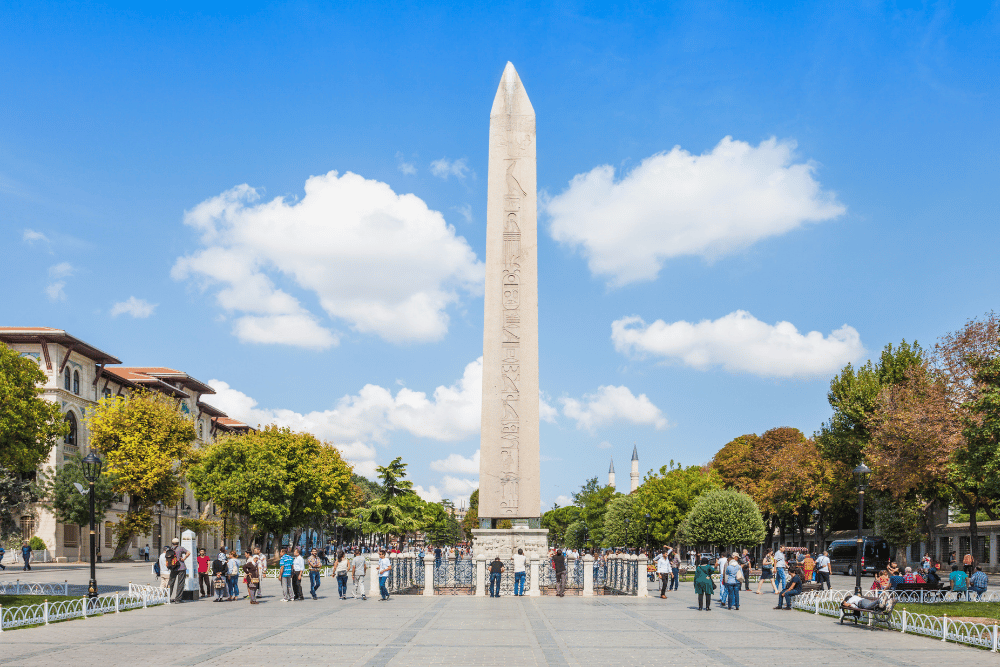
Standing in the center of Sultanahmet Square, the ancient obelisks are among the most striking reminders of Istanbul’s layered history. For travelers exploring the Historic Peninsula, these monuments are often the first symbols that spark curiosity. Long before Sultanahmet became a gathering place for visitors from all over the world, it served as the ceremonial heart of empires.
Today, the square is home to two remarkable structures that continue to fascinate historians and tourists alike: the Obelisk of Theodosius and the Walled Obelisk, also known as the Örme Dikilitaş. These monuments are not only architectural landmarks but also storytellers of ancient civilizations.
Sultanahmet Square: A Stage of Empires
Sultanahmet Square was once known as the Hippodrome of Constantinople, the social and political center of the Byzantine Empire. Chariot races, imperial ceremonies, and public celebrations took place here. The obelisks were erected as symbols of power, continuity, and prestige.
Even today, visitors walking through the square can feel the historical weight of the area. Surrounded by iconic landmarks and cafés, Sultanahmet offers a unique blend of history and everyday life. Harab’be Cafe, located just steps away, allows guests to pause and reflect on these monuments while enjoying the atmosphere of the Old City.
The Obelisk of Theodosius: From Ancient Egypt to Istanbul
The Obelisk of Theodosius is one of the oldest monuments in Istanbul. Originally carved in Egypt during the reign of Pharaoh Thutmose III in the 15th century BC, the obelisk was later transported to Constantinople in the 4th century AD by Roman Emperor Theodosius I.
Historical Journey
- Originally erected at Karnak Temple in Luxor
- Transported to Constantinople in 390 AD
- Installed in the Hippodrome as a symbol of imperial authority
Only the upper portion of the original obelisk survives today, yet it still stands over 18 meters tall. Its survival through centuries of earthquakes, invasions, and political change makes it a remarkable historical artifact.
Carvings and Meaning
The obelisk is covered with ancient Egyptian hieroglyphs praising the pharaoh and celebrating military victories. Its marble base, added during the Roman period, features reliefs depicting Emperor Theodosius and scenes from Hippodrome life. This combination of Egyptian and Roman elements reflects Istanbul’s unique role as a bridge between civilizations.
The Walled Obelisk (Örme Dikilitaş): A Byzantine Mystery
Across from the Obelisk of Theodosius stands the Walled Obelisk, commonly known as the Örme Dikilitaş. Unlike its Egyptian counterpart, this monument was built during the Byzantine era, likely in the 10th century.
Construction and Purpose
Originally covered with bronze plates, the Walled Obelisk once shone brightly in the Hippodrome. These plates were later removed, possibly during periods of conflict or economic hardship, leaving behind the stone core visible today.
While it lacks inscriptions, its scale and placement suggest it was intended to complement the Obelisk of Theodosius and reinforce the grandeur of the Hippodrome.
Why It Still Matters
Though simpler in appearance, the Walled Obelisk represents Byzantine engineering and the empire’s desire to preserve monumental traditions. For history enthusiasts, it offers a quieter but equally meaningful glimpse into Constantinople’s past.
Why Tourists Are Drawn to the Obelisks
Visitors to Sultanahmet are often captivated by the way these monuments coexist with modern city life. Tourists are drawn to the obelisks for several reasons:
- Their ancient origins spanning multiple civilizations
- Their location within walking distance of major landmarks
- Their symbolic representation of Istanbul’s historical continuity
- Their photogenic presence in an open public square
Many travelers pause to read, photograph, and reflect before continuing their exploration. Cafés around the square, including Harab’be Cafe, become natural resting points where visitors discuss what they’ve seen and plan their next stop.
Experiencing History at Your Own Pace
Unlike museums with entry fees or time limits, the obelisks of Sultanahmet can be visited freely at any time of day. Morning light highlights their textures, while evenings bring a calmer, more reflective atmosphere. Sitting nearby with a cup of Turkish coffee allows visitors to truly absorb the setting.
This accessibility makes the obelisks one of the most approachable historical experiences in Istanbul.
A Living Heritage in the Heart of Sultanahmet
The Obelisk of Theodosius and the Walled Obelisk stand as silent witnesses to Istanbul’s transformation across millennia. They remind visitors that Sultanahmet is not just a tourist destination, but a living archive of human history.
For those exploring the area, taking a break at Harab’be Cafe offers the perfect opportunity to enjoy this heritage from a comfortable vantage point, blending history, culture, and everyday life into a single memorable experience.